


Workshops on “Equality and the Law” / “The Concept, Justification and Consequences of Equality as a Core Principle of Law”
Key takeaways
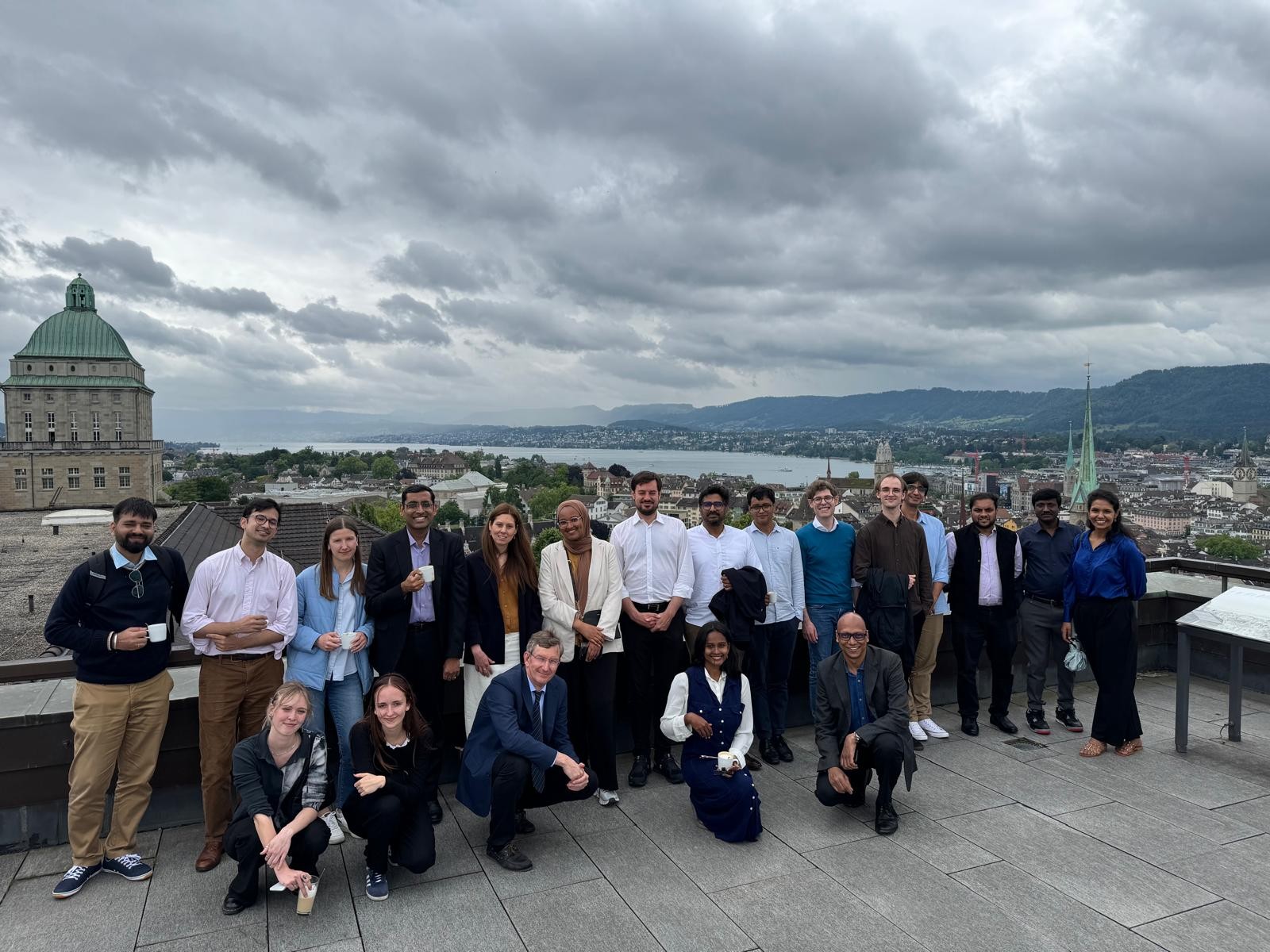
The project aimed at establishing a steady exchange between faculty members, doctoral students, and postdocs of the Faculty of Law, University of Zurich (UZH), and the National Law School of India University (NLSIU), Bangalore, India. Approximately twenty participants met in December 2024 in Bangalore and in June 2025 in Zurich. They presented and discussed their work in progress – be it papers, articles, or chapters from monographs – which dealt with the concept, content and justification of equality as a cornerstone of democracy and the rule of law. The workshops were designed to compare the democratic and legal systems of India and Switzerland with their distinct approach to equality based on different legal traditions, historical and cultural settings, economic circumstances and social challenges. This approach helped to explain differences but also allowed to identify commonalities and generally valid aspects of equality, leading to a universal normative approach to the law.
The project aimed at establishing a steady exchange between faculty members, doctoral students, and postdocs of the Faculty of Law, University of Zurich (UZH), and the National Law School of India University (NLSIU), Bangalore, India. Approximately twenty participants met in December 2024 in Bangalore and in June 2025 in Zurich. They presented and discussed their work in progress – be it papers, articles, or chapters from monographs – which dealt with the concept, content and justification of equality as a cornerstone of democracy and the rule of law. The workshops were designed to compare the democratic and legal systems of India and Switzerland with their distinct approach to equality based on different legal traditions, historical and cultural settings, economic circumstances and social challenges. This approach helped to explain differences but also allowed to identify commonalities and generally valid aspects of equality, leading to a universal normative approach to the law.
The workshops offered unique insights and allowed for an in-depth comparative and interdisciplinary outlook on questions of equality. They developed from a theoretical perspective to concrete legal questions in constitutional, private, and criminal law and addressed both material as well as procedural legal issues since – an important insight – equality can only be established if it is protected by sound legal institutions and fair procedures. It was thought-provoking to engage with case-law from another jurisdiction, not the least because it helped to analyze one’s own domestic legal system. The workshops supported the idea that there is a shared moral outlook across the globe which entails certain fundamental values such as equality. Finally, the participants were able to explore another culture through visits of museums, strolls through cities, and contact with local residents. These experiences are an important part of understanding a society, thus contributing to the comparative approach of the project.
The Leading House’s support was important both on a personal as well as institutional level. It contributed to an international, interdisciplinary network of young scholars, practitioners, and established academics which should lead to the realization of further projects in the future. Additionally, it laid the foundation for a more institutionalized collaboration between the two universities, having led to guest lectures, colloquia and, hopefully, further forms of exchange programs in the time to come. Such a process and development are only possible due to the kind help of the Leading House, not least because it provides stability for planning further workshops.
The participants profited from the workshops on a scientific level since they gained a clearer understanding of equality as a legal concept that –together with human dignity and its legal entrenchment in the form of human rights – necessarily lies at the heart of any sound legal perspective. Departing from this assessment, the project aimed at understanding the features of equality and consequences for the regulation of concrete situations, legal claims, and social challenges. It is important to formulate and hold on to these insights since there is a strong countermovement consisting in contemporary populist movements, relativistic outlooks on values, and illegitimate pursuit of interests. As a counterpoint, the workshops established a unique outlook on law and society across national borders. As could be seen during the course of the discussions, the participants were not divided by cultural backgrounds; rather, they easily found common ground with regard to central contents of the law while discussing diverse topics ranging e.g. from the determination of reasonable criteria for the bench constitution of supreme courts to the regulation of predictive policing or the relevance of human rights (for instance scientific freedom) for democracy. These insights have and will be integrated in the ongoing research of the participants, leading to publications and further projects and thereby enriching the academic and practical discourse.
Additionally, the Swiss participants met representatives of the Alternative Law Forum, a Bangalore-based NGO working on issues of social and economic injustice, during their stay in India. Three members of the ALF-team were subsequently invited to be part of a public podium which addressed the establishment, characteristics, and mechanisms of the Hindu caste system, its religious, social and legal foundation and methods to bring about change. This event contributed to the general awareness not only of the injustice of the caste system itself, but of ideological movements in general, and what kind of antidotes exist.
The project, although ambitious in nature, went very smoothly, mostly due to a very cooperative attitude of both sides of the organizing team as well as the support of the Leading House. This translated directly in highly constructive workshops which were marked not only by excellent contributions from the participants – an even globally unique cluster of scientists and legal practitioners –, but also by heartfelt friendliness: The workshops formed a bond of cordiality among the participants, thereby encouraging them to engage in encounters in the workshops and beyond.
The projects proved to be a highly effective tool for presenting ideas within a consistent group of peers. This allowed for a stimulating environment for intellectual development and for more concise engagement due to the continuing frame of discussion. Having a series of workshops and meeting over the course of months or even years helps to deepen one’s understanding of one’s own theses as well as the growth of the other participants’ projects. As the workshops allowed for the integration of a framework program – which could, for instance, not be replicated through online meetings alone –, the participants not only profited from broadened horizons with regards to a foreign culture but also were able to better contextualize the work and texts of the other researchers.
